
Two Moonshots, One Paradigm Shift
TeraFab, Rapidus, and the Unbundling of the Foundry Model

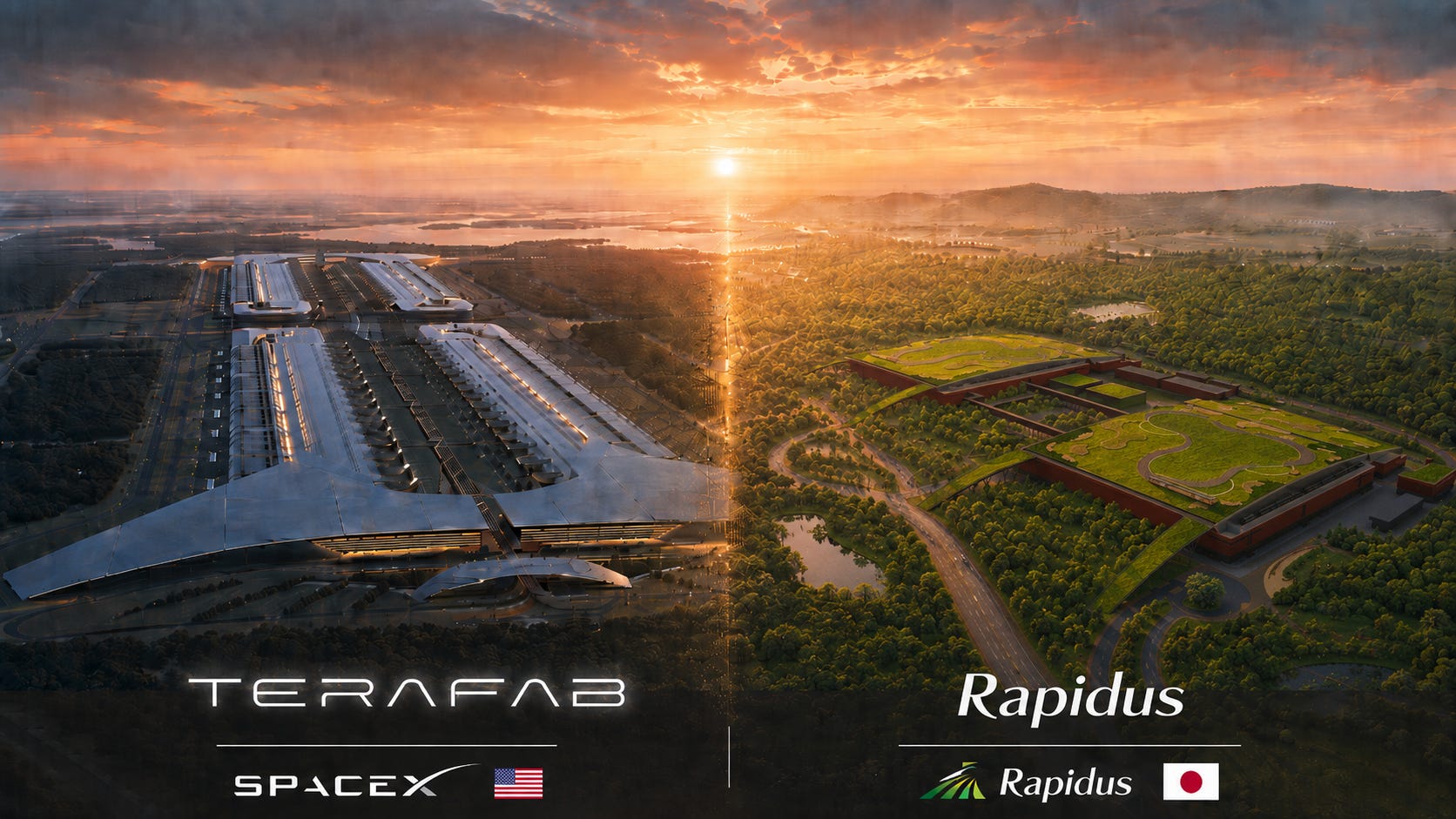
TeraFab and Rapidus may be two of the most fascinating semiconductor manufacturing experiments happening today.
They could hardly look more different.
TeraFab is backed by companies that believe their future semiconductor demand will become enormous, and are willing to put their own capital behind that belief. Rapidus, meanwhile, is Japan’s attempt to rebuild a leading-edge semiconductor manufacturing capability through technology transfer, government support, and a new foundry organization.
One starts with demand and capital.
The other starts with technology and capital.
Yet both are challenging the same decades-old assumption about how the semiconductor industry should be organized.
TeraFab and Rapidus are not trying to beat the foundry model at its own game. They are trying to “unbundle” it.
And that is precisely what makes them so interesting, so eye-catching, and so extraordinarily difficult to pull off.
Why the Foundry Model Won
To understand why TeraFab and Rapidus matter, we first need to understand why the foundry model became so dominant in the first place.
The economics of advanced semiconductor manufacturing have become progressively more brutal. Every new generation of process technology requires larger R&D investment. The equipment needed to manufacture it becomes more sophisticated and expensive. At the same time, the capital intensity of a leading-edge fab keeps rising, while the amount of production required to economically absorb those fixed costs becomes larger.
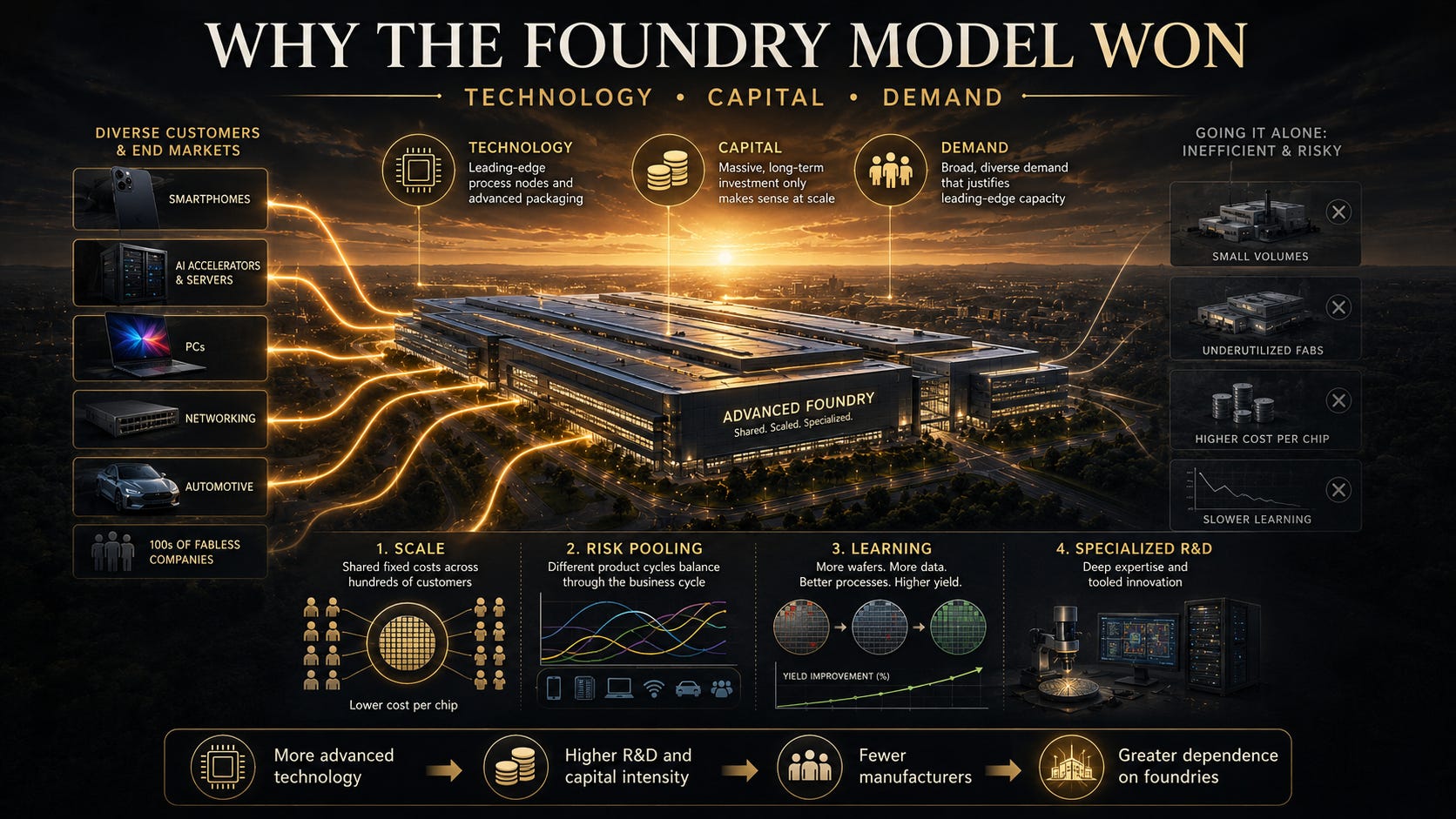
This creates a simple problem. To pursue the leading edge, a semiconductor company needs three things simultaneously: Technology, Capital, Demand.
Technology: It needs enough R&D resources to develop the process.
Capital: It needs enough capital to build manufacturing capacity.
Demand: And, perhaps most importantly, it needs enough wafer demand to keep that extremely expensive capacity loaded.
Lose any one of those three, and the economics begin to fall apart. That is why the foundry model became so powerful.
Instead of Apple, Nvidia, AMD, Qualcomm, Broadcom, MediaTek and hundreds of smaller fabless chip designers each developing their own process technology and building their own fabs, a foundry can aggregate their demand.
The foundry develops the process once and builds the fabs, then many customers share the enormous fixed cost.
As semiconductor manufacturing became more capital-intensive, the number of companies capable of remaining at the leading edge rapidly shrank. GlobalFoundries famously suspended its 7nm development in 2018, while UMC increasingly focused its resources on mature or differentiated nodes rather than continuing the leading-edge race. Today, the difficulty of reaching high-volume manufacturing at the frontier is even more obvious.
But scale is only part of the foundry advantage. There is another benefit that is often underappreciated:
risk pooling.
Apple demand can weaken while Nvidia demand rises; Smartphones can slow while AI accelerators explode; One customer’s product cycle can be delayed while another customer’s product ramps early.
A large foundry can aggregate these independent demand curves and maintain utilization far more efficiently than a single-product IDM.
And there is yet another advantage:
learning.
More customers and more wafer starts mean more defect data, more yield-learning opportunities, more process-window optimization, and more chances to improve manufacturing economics.
So the foundry model bundles several powerful economic advantages together: economies of scale, demand aggregation, risk pooling, process learning, and specialized R&D.
For decades, the direction of travel appeared obvious:
More advanced technology → higher R&D and capital intensity → fewer manufacturers → greater dependence on foundries.
But there is an assumption hidden inside that equation. The foundry must actually be able to provide the sufficient capacity customers need.
And that assumption is becoming much more interesting in the AI era.
The Hidden Foundation of the Foundry Model: Capacity
Imagine there is one printing company, which can print 100 newspapers per day. Five newspaper publishers rely on it.
As long as total demand remains below 100, the arrangement is wonderful. Each publisher can specialize in journalism instead of wasting capital building its own printing press. Everyone benefits from specialization.
But suppose demand suddenly rises to 150. Now something fundamentally changes.
Producing more copies for Newspaper A necessarily means producing fewer copies for Newspaper B. Capacity allocation becomes strategic.
Newspaper B suddenly realizes that its ability to grow is no longer determined purely by how many readers want its product. It is determined by whether somebody else’s factory decides to allocate enough capacity to it.
If B gets printing capacity, it has revenue. If B doesn’t, it doesn’t.
At some point B asks a very different question:
Why should the future of my business depend entirely on somebody else’s willingness to build capacity for me?
Initially, B will probably find another printing company, then perhaps it will sign a longer contract; maybe it will prepay for capacity.
But if every printer is constrained, and if B genuinely believes its future demand will become enormous, eventually another option appears:
Build the printing press yourself.
Traditionally, this would appear irrational because the specialized printer should be more efficient. But the optimization problem has changed. The question is no longer:
Who can manufacture my product most efficiently?
It becomes:
Who can guarantee that my product gets manufactured at all?
That difference is crucial.
When Dependency Costs More Than Specialization Saves
This is where the economics become more interesting. The foundry model implicitly assumes:
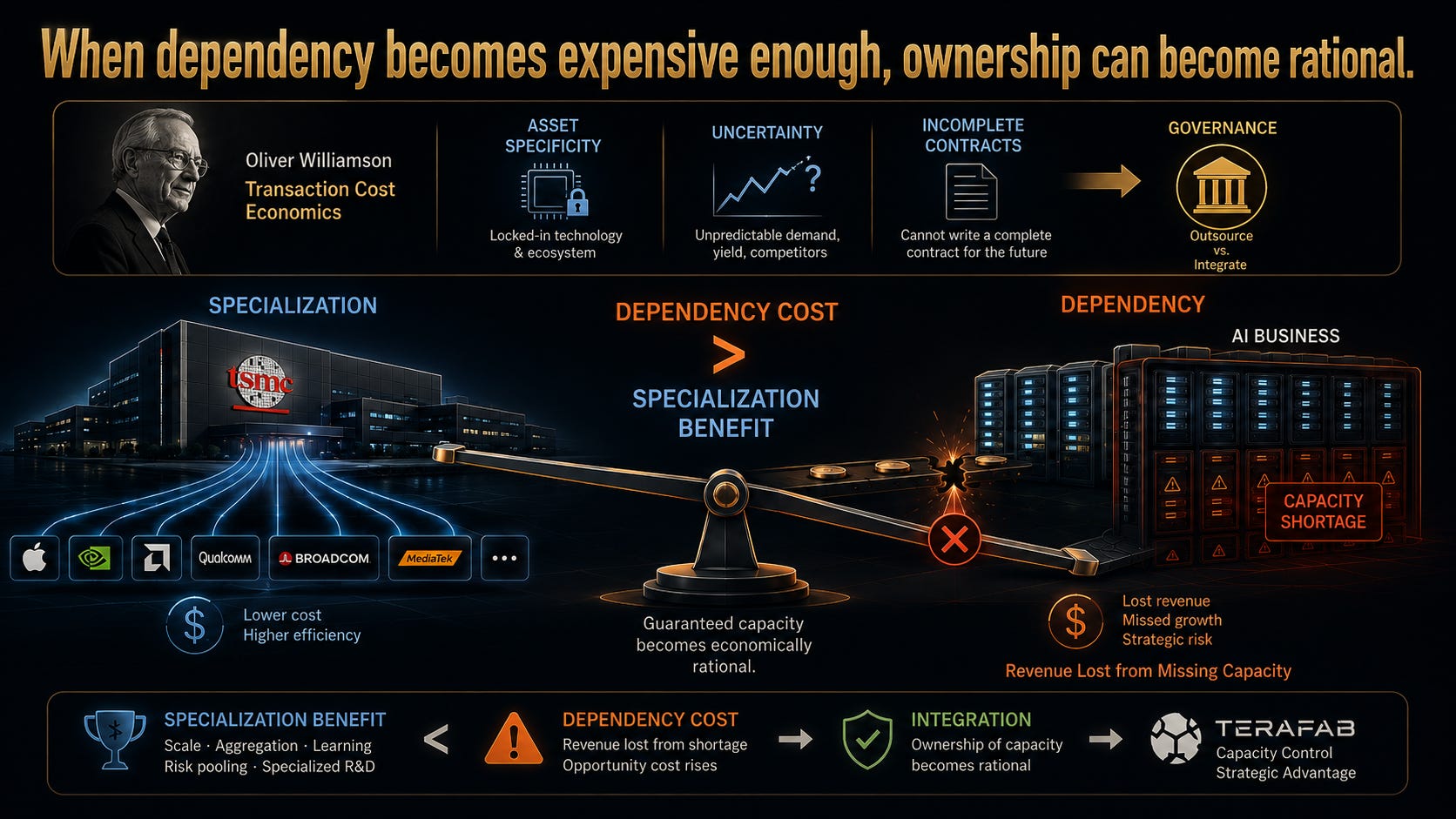
Benefit of specialization > Cost of dependency
And for decades, that was overwhelmingly true. Owning your own leading-edge fab simply to avoid dependence on TSMC would have been an extraordinarily expensive insurance policy.
But imagine a world where a wafer shortage prevents you from selling billions of dollars of highly profitable AI systems. Suddenly the equation changes. The relevant comparison is no longer merely:
TSMC wafer cost vs. internal wafer cost.
It becomes:
Efficiency gained from outsourcing vs. revenue lost from not having capacity.
If the opportunity cost of a missing wafer becomes high enough, paying more to own guaranteed capacity can become rational. In other words:
The value of guaranteed capacity can eventually exceed the efficiency advantage of outsourcing.
That does not mean vertical integration suddenly becomes cheap. The internal fab still brings utilization risk, depreciation, execution complexity, process-transfer risk and enormous capital requirements.
It simply means that dependency itself has become expensive enough to matter.
And that is where industrial economics becomes useful.
Capacity Shortage Is Also a Governance Problem
One way to understand what is happening is through Transaction Cost Economics.
A semiconductor foundry relationship has an unusually dangerous combination of characteristics:
high asset specificity, high uncertainty, and incomplete contracts.
Consider what happens when a foundry builds capacity around a customer’s expected demand. A leading-edge fab requires massive sunk investment years before revenue arrives. Equipment configuration, process qualification, engineering resources and capacity timing may all be influenced by the customer’s expected product roadmap.
The foundry therefore takes a risk:
What if the customer promises enormous demand, but the demand never arrives?
The customer also makes highly specific investments. A leading-edge chip is designed around a particular PDK, design rules, IP ecosystem, SRAM, SerDes, packaging architecture and process characteristics.
Moving a completed product from one advanced node to another foundry is hardly equivalent to changing an email recipient and sending over the same GDS file. So both sides become dependent on each other.
Now add uncertainty.
Nobody knows precisely how AI demand will evolve three years from now. Nobody knows exactly how fast a new process will yield. Nobody knows what competing customers will demand from the same capacity. And nobody can write a contract that perfectly specifies the allocation, pricing, yield responsibility and volume commitment for every possible future state of the world.
That creates a classic problem. The customer says:
“I will need enormous capacity in five years.”
The foundry responds:
“Prove it.”
The customer cannot.
And the foundry rationally hesitates to spend tens of billions of dollars based entirely on someone else’s forecast. This can create underinvestment relative to what the customer believes it will need.
That is why one sentence captures the logic behind TeraFab unusually well:
If the foundry doesn’t believe your demand forecast enough to build ahead of it, you have two choices: constrain your ambition, or fund the forecast yourself.
TeraFab chose the latter.
Capacity shortage exposes a governance problem that specialization had hidden for decades.
TeraFab: The Rise of the “Synthetic” IDM
This is why I think TeraFab should not be understood simply as “Elon Musk building a giant fab.” Its more interesting implication is organizational.
SpaceX have committed an initial $16.8 billion to the Texas TeraFab project, which is envisioned as an enormous semiconductor complex integrating fabrication with other parts of the manufacturing chain. Intel has separately confirmed its participation in the project, and Elon Musk has said that TeraFab intends to use Intel’s 14A manufacturing process. Conceptually, the direction is fascinating.
Tesla, SpaceX and xAI possess something most semiconductor startups do not:
enormous capital and potentially enormous captive demand.
What they do not possess is decades of advanced process development and high-volume semiconductor manufacturing experience.
Intel has those capabilities.
Put the pieces together and a new organizational form begins to emerge.
I call it the:
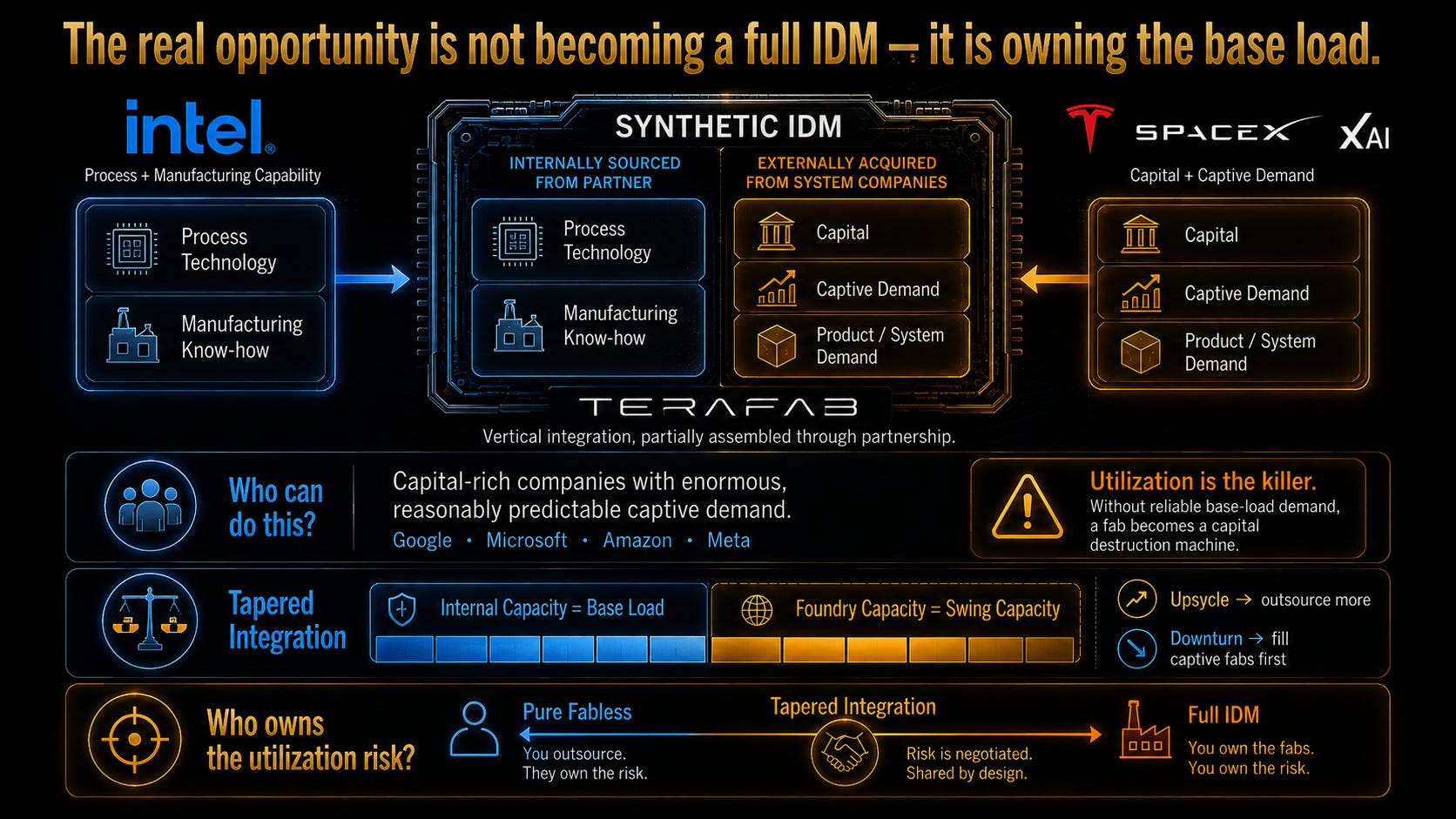
Synthetic IDM
A traditional IDM internalizes almost everything:
Product + Process + Fab + Manufacturing
A fabless company internalizes the product but outsources manufacturing:
Product internal; Process + Fab + Manufacturing external
A Synthetic IDM is different:
Product + Demand + Capital / manufacturing assets internal
Process technology + part of the manufacturing know-how acquired externally
It recreates vertical integration without requiring the system company to independently reproduce thirty years of process R&D.
But the company does not become Intel. It assembles an Intel-like organizational capability through partnerships. That distinction matters.
Why Hyperscalers Should Be Watching
If TeraFab succeeds, I don’t think the most important audience will be traditional semiconductor companies. It will be hyperscalers.
Google, Microsoft, Amazon and Meta increasingly design custom silicon because compute is becoming too strategic to outsource entirely at the chip-design level. But manufacturing has remained a very different proposition. Building a leading-edge fab is difficult enough and developing a competitive leading-edge process from scratch is considerably more absurd. TeraFab potentially asks whether those two problems can be separated:
What if a company does not have to reinvent the transistor?
What if advanced process technology and manufacturing expertise can be acquired from a semiconductor partner while the customer supplies its own capital and demand?
Then the barrier to vertical integration changes. But capital alone is not sufficient.
The real candidates are:
capital-rich companies with enormous, reasonably predictable, internally generated semiconductor demand.
Because utilization remains the killer. A company that builds a $30 billion fab and then discovers it needs half the expected wafers has merely invented a particularly sophisticated way to destroy capital. The TeraFab model only works if captive demand is large enough to establish a reliable base load.
And that leads to a model I suspect may become more relevant:
Tapered integration
Instead of becoming a full IDM, a company manufactures a strategic baseline internally and continues to outsource incremental demand.
For example:
Internal capacity = base load
Foundry capacity = swing capacity
During an upcycle, the company outsources more to TSMC, Intel Foundry or Samsung.
During a downturn, it reduces outsourcing and fills its captive fabs first.
This provides some of the supply security of an IDM while retaining some of the flexibility and risk pooling of the foundry model. Of course, outsourced capacity is not a free call option. Foundries will not happily build billions of dollars of capacity just so customers can disappear during the next downturn. They will respond with LTAs, prepayments, take-or-pay commitments, customer-funded tools and other mechanisms designed to push utilization risk back toward the customer.
So the real battle becomes:
Who owns the utilization risk?
That may become one of the defining questions of the next generation of foundry contracts.
The Nvidia Problem and the Newspaper B Problem
This also explains why not every large semiconductor customer has the same incentive to integrate. Imagine Newspaper A already prints enormous volumes.
The printing company knows A’s demand exists, knows it is profitable, and knows additional capacity built for A will probably be utilized. Newspaper A does not have much reason to build its own press. Its scale already provides capacity security.
Now imagine Newspaper B: Its current volume is much smaller, but B believes its future demand will explode. It asks the printer to build enormous capacity today based on what B believes it will need tomorrow.
The printer may not believe the forecast. This creates a strange asymmetry:
the customer owns the upside of being right, while the foundry may bear much of the capital cost of being wrong.
Naturally, the foundry is conservative.
In today’s semiconductor market, Nvidia increasingly resembles Newspaper A. TeraFab represents the extreme Newspaper B response:
If you don’t believe my forecast, I will put my own balance sheet behind it.
That is a very different proposition from simply asking for more wafers.
Rapidus Is Running the Opposite Experiment
Then there is Rapidus.
If TeraFab begins with demand + capital and seeks manufacturing technology, Rapidus begins much closer to the opposite end of the spectrum.
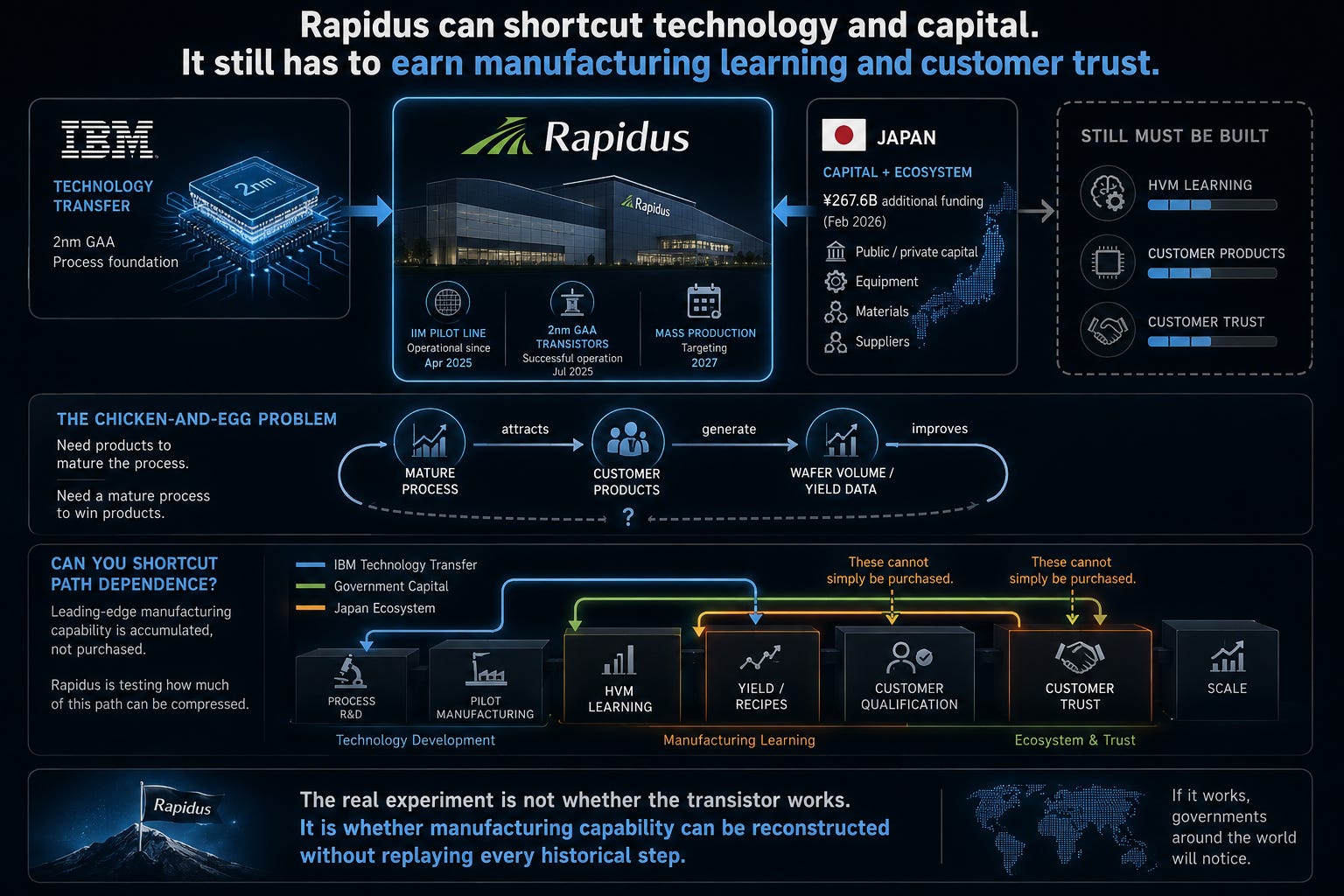
Rapidus entered into a strategic partnership with IBM to jointly advance 2nm technology. Its engineers have trained alongside IBM researchers in Albany, while Rapidus has been building its own manufacturing operation in Hokkaido. Its IIM pilot line has operated since April 2025, and Rapidus reported successful operation of 2nm GAA transistors in July 2025. It continues to target mass production in 2027.
The financial backing is also substantial. In February 2026, Rapidus announced ¥267.6 billion in additional funding from the Japanese government and private-sector investors as it moves from R&D toward mass production.
But Rapidus faces a fundamentally different challenge.
The IBM 2nm technology originated in a research environment. IBM demonstrated its 2nm nanosheet technology on a 300mm research wafer in 2021, and IBM itself describes the subsequent Rapidus collaboration as the work required to turn that breakthrough into production-ready and eventually large-scale manufacturing technology.
That distinction is enormous, and manufacturing learning requires products, preferably a lot of them.
This creates the classic chicken-and-egg problem:
You need customer products to mature the process.
Customers want a mature process before trusting you with their products.
Rapidus already has partnerships and an expanding customer-facing ecosystem, but its publicly visible captive or committed demand base is very different from the built-in demand thesis behind TeraFab.
That is why, in my view, Rapidus is the longer shot.
Can You Shortcut Path Dependence?
For decades, leading-edge semiconductor manufacturing has been treated as a profoundly path-dependent capability. The capability is accumulated: Process integration knowledge, yield learning, equipment recipes, supplier coordination, and customer trust.
Rapidus is effectively testing an extraordinary proposition:
How much of technological path dependence can be shortcut through technology transfer, government capital and an existing semiconductor ecosystem?
IBM technology transfer can shorten part of the technology-development path. Japanese public financing can shorten the capital-accumulation path. Japan’s extraordinary equipment and materials ecosystem helps reduce another barrier.
But Rapidus cannot simply purchase years of high-volume manufacturing learning and customer trust. Those still have to be earned.
That is why the real Rapidus experiment is bigger than whether its transistor works.
It is testing whether a country that lost leading-edge logic manufacturing can reconstruct the organizational capability without replaying every historical step that created today’s incumbents. If it works, governments around the world will notice.
Two Experiments, Two Different Audiences
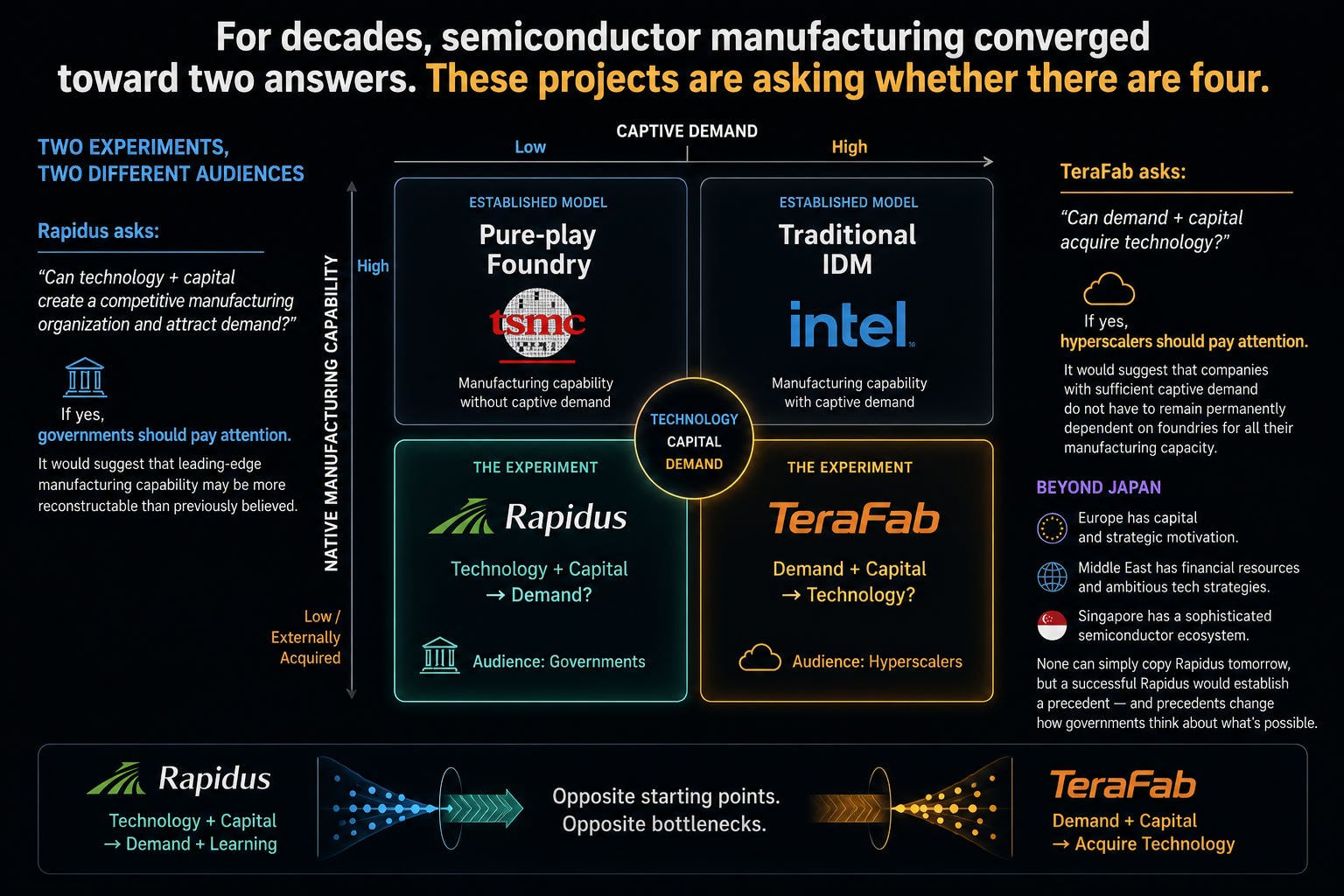
This is the symmetry that makes TeraFab and Rapidus so compelling.
TeraFab asks:
Can demand + capital acquire technology?
If the answer is yes, hyperscalers should pay attention.
Because it would suggest that companies with sufficient captive demand do not necessarily have to remain permanently dependent on the traditional foundry model for all their manufacturing capacity.
Rapidus asks:
Can technology + capital create a competitive manufacturing organization and attract demand?
If the answer is yes, governments should pay attention.
Because it would suggest that leading-edge manufacturing capability may be more reconstructable than previously believed, provided a country can obtain the technology, finance the learning curve and build enough customer trust.
The implications extend well beyond Japan. Europe has capital and strategic motivation. Several Middle Eastern economies have extraordinary financial resources and increasingly ambitious technology strategies. Singapore already possesses a sophisticated semiconductor manufacturing ecosystem.
None can simply copy Rapidus tomorrow, but a successful Rapidus would establish a precedent. And precedents change how governments think about what is possible.
The Two Missing Quadrants
For decades, the industry has largely converged around two dominant organizational forms. One is the pure-play foundry, the other is the traditional IDM.
But think about the industry across two dimensions:
Does the organization possess native manufacturing capability?
Does it control large captive demand?
This is deliberately simplified, but it reveals something interesting.
Foundry and IDM are corner solutions.
TeraFab and Rapidus are exploring the other organizational spaces.
TeraFab attempts to compensate for missing native process capability with captive demand, capital and an external manufacturing partner.
Rapidus attempts to compensate for the absence of an established customer base and accumulated leading-edge manufacturing history through transferred technology, public capital and accelerated learning.
For decades, semiconductor manufacturing appeared to be converging toward two answers. These projects are asking whether there are more.
The Foundries Will Not Sit Still
There is one more reason I do not think this story ends with hyperscalers simply building their own fabs. If customers can unbundle the foundry, foundries can unbundle themselves too.
Today’s foundry typically sells something that looks conceptually simple:
a processed wafer
But the capabilities underneath that wafer are far more extensive:
process technology,
fab design,
tool installation,
manufacturing operations,
yield ramp,
design enablement,
advanced packaging,
capacity,
supply-chain management.
There is no law saying these capabilities must always be sold as one bundled product.
A future semiconductor manufacturer could offer different customers different combinations:
Process IP
Manufacturing services
Customer-funded equipment
Dedicated production lines
Joint-venture fabs
Fab operating services
Yield-ramp support
Advanced packaging
Traditional outsourced wafer capacity
In other words:
If Synthetic IDMs emerge on the customer side, modular foundries may emerge on the supplier side.
That could be the industry’s actual response. It’s not the death of the foundry, it’s an evolution.
The Foundry Model Is Not Dying. Its Boundaries May Be Moving.
I do not believe TeraFab proves the fabless model is obsolete, nor does Rapidus prove that any wealthy government can buy its way into 2nm manufacturing.
If anything, both projects demonstrate just how powerful the traditional foundry model is. They must assemble extraordinary amounts of technology, capital, talent and demand merely to recreate pieces of what a successful leading-edge foundry already provides.
But that is precisely why they matter. For roughly three decades, the organizational direction of advanced semiconductor manufacturing looked increasingly settled:
Design companies design.
Foundries develop processes and manufacture.
IDMs survive only where the economics justify maintaining both capabilities internally.
AI is making that boundary fluid again, not because specialization suddenly stopped working, but because the cost of dependency is changing.
When semiconductor capacity becomes a direct constraint on the growth of a trillion-dollar compute business, the value of manufacturing control rises dramatically.
When governments begin treating leading-edge manufacturing as strategic infrastructure rather than merely another private industry, the acceptable return threshold on semiconductor investment changes as well.
And when process technology, fab capital, manufacturing expertise and demand can potentially be sourced from different organizations, the old organizational boundaries become less inevitable.
That is what TeraFab and Rapidus are really testing.
The resurgence of vertical integration may not mean the return of the traditional IDM. It may mean the emergence of Synthetic IDMs on the customer side and modular foundries on the supplier side.
TeraFab has the demand; Rapidus has the technology-transfer pathway.
Both have capital; Both are attempting to acquire what they do not naturally possess.
Neither path will be easy.
The probability of failure is precisely what makes these projects worth watching, because if one succeeds, it creates a precedent. If both succeed, they do something considerably more important than adding two new leading-edge fabs.
They prove that the architecture of the semiconductor industry itself can be redesigned.
And that may be the real paradigm shift.
The Inteller.